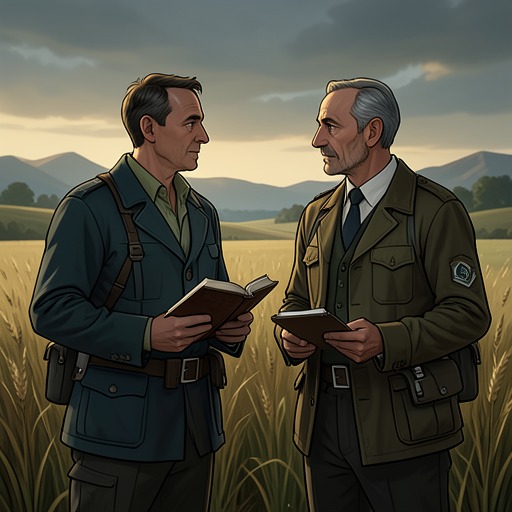
“You have forgotten your childhood”
Narcissus and Goldmund“You have forgotten your childhood” is Narcissus’s diagnosis of Goldmund’s buried past and the phrase that returns at the instant Goldmund recovers the image of his mother. It connects Narcissus’s insight into Goldmund’s divided nature with a painful, transformative act of remembering: the words first describe an absence, then help make that absence visible to Goldmund himself.
Narcissus’s Diagnosis
Narcissus presents Goldmund’s forgetfulness as more than a gap in conscious memory. He tells him that his reason and his innermost drives lie far apart, and that the forgotten childhood is crying from the depths of his soul. Until Goldmund attends to it, Narcissus warns, it will continue to make him suffer. The phrase thus names a separation between conscious understanding and the force of Goldmund’s unacknowledged experience.
The diagnosis emerges as part of Narcissus’s account of their contrasting natures. He describes Goldmund as a dreamer and artist, formed by feeling and by a maternal inheritance, while Narcissus identifies himself with the life of reason and wakefulness. In that contrast, the forgotten childhood is not incidental: it is bound to the emotional and imaginative life Goldmund has lost access to, and to the self he has yet to find.
The Phrase Returns as Memory Breaks Through
Goldmund’s response to the words reveals their force before he understands their meaning. When Narcissus says that he has forgotten his childhood, Goldmund flinches as though struck, while Narcissus, speaking with his eyes closed or fixed ahead, does not see the change in his face. The bodily reaction registers what Goldmund cannot yet explain: the statement has touched something buried.
Later, as Goldmund wakes from a strange and painful inner experience, he struggles to recover what he has seen. Images of three dogs’ heads and the scent of roses surface amid his confusion. In the rapidly vanishing dream world, he finds the image again: a tall, radiant woman with glowing hair and a full mouth. He recognizes her as his mother, and hears the phrase in his mind—“You have forgotten your childhood.” He then identifies the voice as Narcissus’s. The words recur not as a new explanation but as the prompt through which the recovered image becomes intelligible.
Recognition and Consequence
The act of remembering is both painful and joyful. Goldmund’s mother returns to his awareness with her regal light-blue eyes, while what he describes as mountains of rubbish and oceans of forgetfulness collapse and disappear. The phrase marks the passage from an unnamed, inaccessible experience to recognition: Goldmund can now see what had been lost and understand why Narcissus’s words affected him so sharply.
Afterward, Goldmund recognizes how Narcissus’s questions and observations have helped him become clear to himself. He recalls that Narcissus identified his maternal nature and the spell of forgotten childhood, and asks how Narcissus knows people so well. Narcissus explains that recalling Goldmund’s mother hurt him deeply; Goldmund had been found lying as though dead in the cloister garden. In this sequence, the phrase serves as a hinge between Narcissus’s interpretive insight and Goldmund’s recovery of memory, while the pain of that recovery confirms that remembering is not merely an intellectual exercise.